Misconceptions Non-Technical Founders Have When Working With a Development Agency
Most friction between founders and development agencies doesn't come from bad work. It comes from a handful of assumptions that feel intuitive — but don't hold up once you're actually building software.
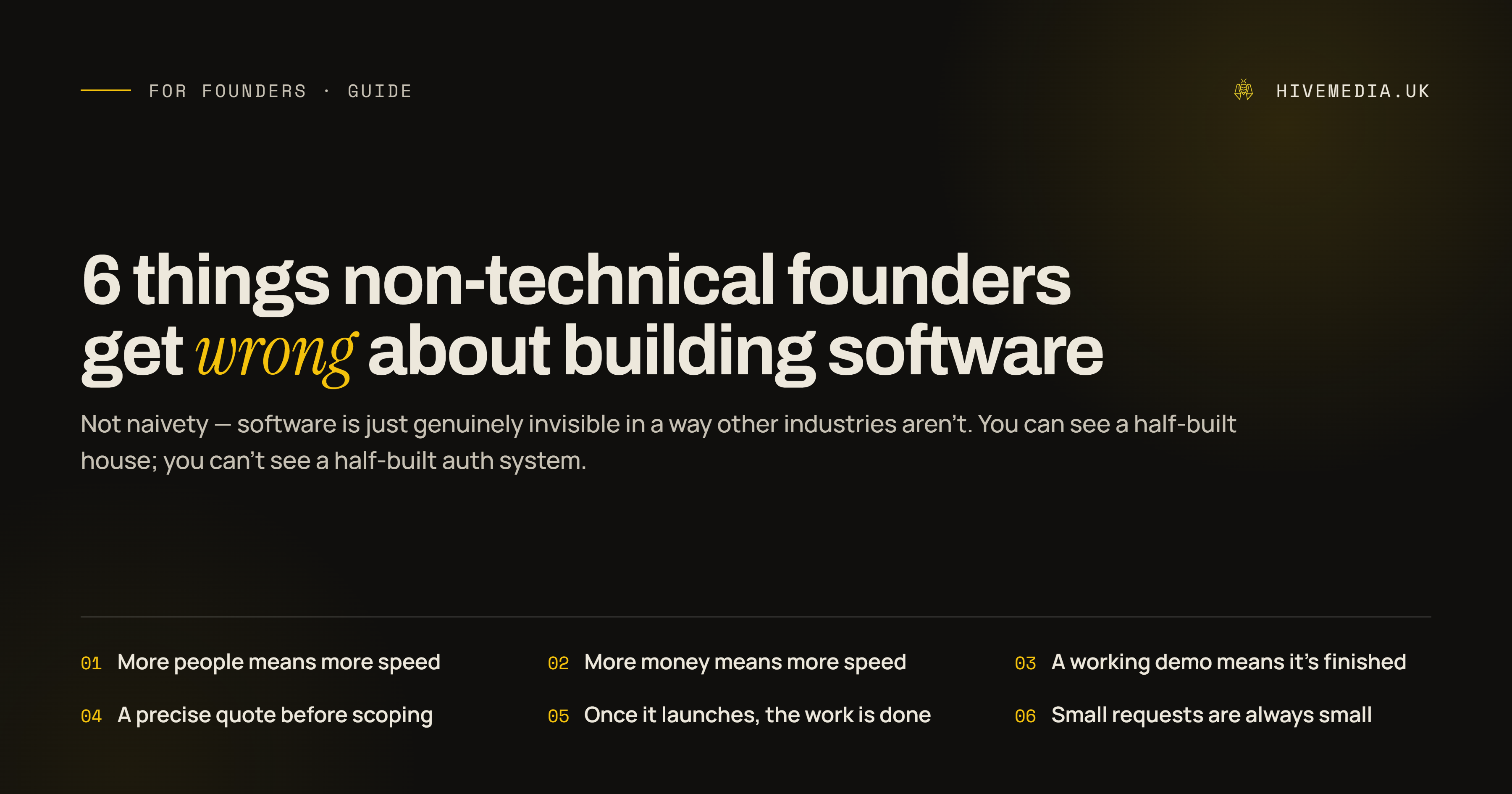
Misconceptions Non-Technical Founders Have When Working With a Development Agency
Most friction between founders and development agencies doesn't come from bad work. It comes from a handful of assumptions that feel intuitive — but don't hold up once you're actually building software.
1. More people means more speed
Two pregnant women cannot make one child faster than one. Some parts of building software are sequential by nature — you can't shortcut them by throwing more hands at the problem.
And it can work the other way too. Add too many people to a project and you get "too many cooks in the kitchen" — more communication overhead, more conflicting decisions, more time spent coordinating instead of building. Past a certain point, adding people can slow a project down, not speed it up.
2. More money means more speed
Budget can buy more experienced people, better tools, or the ability to run workstreams in parallel — but it can't skip the thinking. Discovery, architecture, and testing all take the time they take. You can hire more chefs, but you still can't cook a meal before the ingredients have arrived.
3. A working demo means it's basically finished
This is the gap that catches almost every non-technical founder out at some point. A demo that works in front of you isn't the same as a product that works for thousands of real users, on real networks, with real data.
AI is making this worse, not better. It's now trivial to prototype something that looks and feels like a finished product in an afternoon — and easy to walk away thinking "I've basically built this already." What's usually missing is everything a user never sees: security, error handling, edge cases, the ability to survive real traffic, and the unglamorous plumbing that turns a convincing demo into something you could actually run a business on. That gap is often where most of the real engineering work — and cost — lives.
4. A fixed, precise quote is possible before anything is scoped
Asking for an exact price before any discovery work is like asking a builder to quote a house with no blueprint. A good agency can give you a range early on — but a precise number only becomes possible once the scope is actually defined.
5. Once it launches, the work is done
Software is closer to a garden than a monument. It needs ongoing attention — security patches, dependency updates, fixes as real usage reveals issues you couldn't have predicted. Treating launch as the finish line is one of the most common reasons "finished" products start falling apart six months later.
6. Small feature requests are always small
"Just add a button" often sounds simple because you're only picturing the button. Underneath it, there's usually new logic, new data to store, new permissions to check, and new edge cases to handle. The size of a request on the surface rarely matches the size of the work underneath it.
A real example: a client wanted sellers on a marketplace we built to be able to edit the price of their own listings. On paper, that sounds like a form field and a save button.
But we're not thinking of it that simply — we're thinking about what happens if a buyer is checking out at the exact moment a seller edits the price. Do they pay the old price or the new one? What if the price changes mid-payment? What if two people are checking out at once, at two different prices, and only one edit should win?
None of that is visible in the original request. It only shows up once you start asking what could go wrong — and it's the difference between a feature that works in a demo and one that works when real money is moving through it.
The takeaway
None of these misconceptions come from founders being naive — they come from software being genuinely invisible in a way other industries aren't. You can see a half-built house. You can't see a half-built authentication system.
The founders who get the best results aren't the ones who understand the code — they're the ones who go in expecting the process to take real thought, not just resource.